Pain relief in the treatment of haemorrhoids
- Should you take painkillers for haemorrhoids, can you rely on folk remedies, and what is actually the most effective medicine for haemorrhoids?
- Haemorrhoids are a complex disease. And their main difficulty is that, according to statistics, most patients put off treatment for a long time, even when they know they have the condition. A visit to a proctologist and the treatment that follows seem too awkward. This attitude to one's own health often means that one far-from-fine day the patient urgently needs pain relief, as well as therapy aimed at reducing swelling, inflammation and bleeding. That is what we will talk about today.
How to relieve haemorrhoid pain
Pain is a common symptom of both internal and external haemorrhoids. However, with the external form of haemorrhoids, the pain can be much more severe and occur with any movement: the muscles compress the thrombosed haemorrhoidal node, which is surrounded by numerous nerve endings. As a result, the patient is unable to walk, sit or even lie down normally. In this case, pain relief is essential.
Topical painkillers
Haemorrhoid pain can be relieved quickly and reliably with suppositories and ointments containing anaesthetics. Choose a form of the medicine that you can apply directly where the haemorrhoidal nodes are located. If you have internal haemorrhoids and the discomfort is caused by nodes located in the rectum, use suppositories containing an anaesthetic, or any others prescribed by your proctologist.
If the nodes are located outside, it is better to use a cream, gel or ointment. Ointments containing a local anaesthetic are prescribed most often. In addition to relieving pain, they relieve tension and inflammation, eliminate itching and promote healing.
Systemic painkillers
Whether you need to take painkillers for haemorrhoids depends on how severe the pain is. If the pain is acute and topical products do not bring noticeable relief, tablets with an analgesic effect may be taken. Tablets relieve pain quickly and effectively, but they have a number of contraindications. In addition, they must not be used on a continuous basis.
Folk remedies for pain relief
Among folk remedies for pain relief, cool sitz baths can be recommended. But remember: they should be taken for no more than five minutes.
Treating haemorrhoids
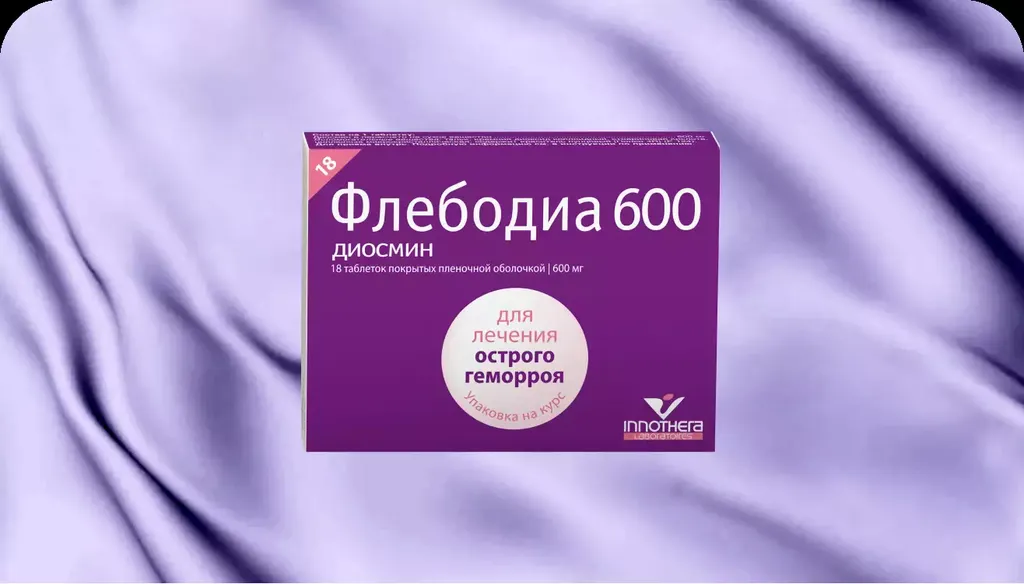
Relieving pain is an important measure in haemorrhoids, but not the only one. Haemorrhoidal nodes are vascular plexuses, so in haemorrhoids it is important to increase the tone of the veins of these nodes and reduce inflammation in them. For this purpose, venotonics – medicines that act on venous tone – are widely used, for example Phlebodia 600 or others. These medicines are also used for diseases of the leg veins and varicose veins. However, today many medicines are produced specifically for the treatment of haemorrhoids. In particular, Phlebodia 600 is available in a pack designed for a course of treatment of acute haemorrhoids. The 18 tablets in the pack are fully sufficient for a 7-day course of treatment. Your doctor will explain in detail how to take Phlebodia 600. The medicine is taken with meals. For the first four days – 1 tablet three times a day, and then for three days – 1 tablet twice a day. Once the acute symptoms of haemorrhoids have been relieved, it is recommended to continue taking Phlebodia 600 at 1 tablet once a day for one to two months. It is important to note that taking venotonics not only helps to strengthen the vessel walls but also helps to relieve pain.
By way of conclusion
Haemorrhoids are a disease that requires a great deal of personal responsibility and a comprehensive approach. Do not ignore the symptoms at the stages when they do not yet cause serious discomfort, because in that case timely treatment will allow you to get rid of the disease quickly, painlessly and for a long time. If you have already let the disease progress and it is causing you suffering, do not focus only on relieving the pain. Yes, living with pain is hard, and you want to get rid of it as quickly as possible. Take fast-acting pain relief measures for this, but do not put off examination and treatment as soon as the pain subsides. Take care of yourself – see a doctor, complete a course of treatment and make time for prevention. Do not look for the best medicine for haemorrhoids by trial and error; let your doctor choose it for you. A visit to a proctologist may not be a pleasant event, but it can save you from many problems in the future. So take responsibility for your health and take the necessary measures. Your body will certainly thank you for it!